💻✏Trigonometry Basics
1) Circular System Radian Measure
Statement: In the circular system of angle measurement, the unit is the radian. One radian is the angle subtended at the center of a circle by an arc whose length is equal to the radius.
- \(1\ \text{right angle} = \frac{\pi}{2} \ \text{rad}\)
- \(1\ \text{straight angle} = \pi \ \text{rad}\)
- \(1\ \text{complete angle} = 2\pi \ \text{rad}\)
- Relation: \( 1^\circ = \frac{\pi}{180} \ \text{rad} \)
Convert Degrees to Radians
Solution:
\[ 75^\circ = 75 \times \frac{\pi}{180} = \frac{5\pi}{12} \ \text{rad} \]Angle Conversion – Worked Variations Deg ⇄ Rad
Convert Degrees + Minutes to Radians
2) Trigonometric Ratios Right-Angled Triangle
Statement:
Trigonometric ratios (T-ratios) relate the angles of a right-angled triangle to the ratios of its sides.
Consider a right triangle \( \triangle ABO \) with:
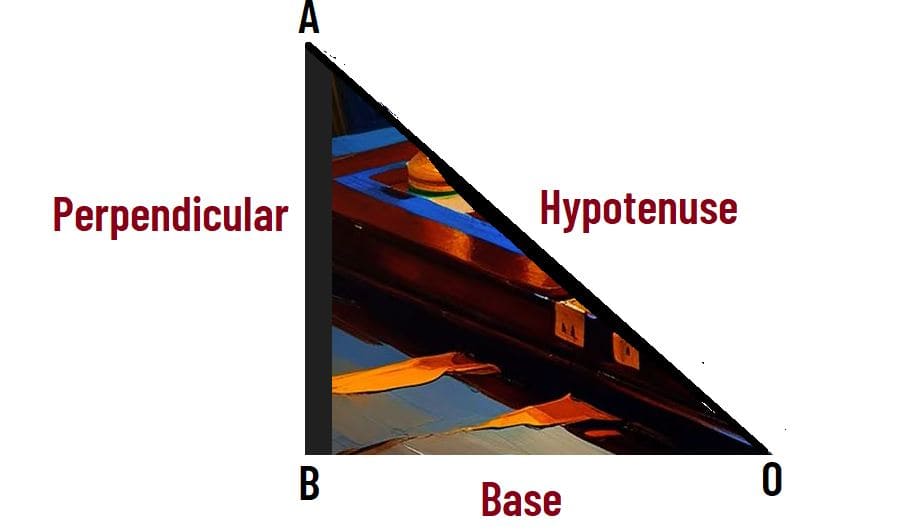
- \(AB\) = perpendicular
- \(OB\) = base
- \(OA\) = hypotenuse
Solution:
Hypotenuse \(OA = \sqrt{3^2 + 4^2} = 5\). \[ \sin\theta = \frac{3}{5}, \quad \cos\theta = \frac{4}{5} \]Question 1:
If \( \sin \theta = \frac{3}{5} \), where \( \theta \) lies in the first quadrant, find all the other trigonometric ratios. \[\textbf{Solution:}\] Let \( \triangle PQR \) be a right-angled triangle, right-angled at \( Q \).
\[ \sin \theta = \frac{3}{5} \quad \Rightarrow \quad \text{Hypotenuse (PR)} = 5, \quad \text{Opposite side (PQ)} = 3 \] On applying the Pythagorean theorem in \( \triangle PQR \), we get: \[ (\text{Hypotenuse})^2 = (\text{Opposite})^2 + (\text{Adjacent})^2 \] \[ 5^2 = 3^2 + (\text{Adjacent})^2 \quad \Rightarrow \quad 25 = 9 + (\text{Adjacent})^2 \] \[ \text{Adjacent} = \sqrt{25 - 9} = \sqrt{16} = 4 \] Now, we calculate all the trigonometric ratios: \[ \cos \theta = \frac{\text{Adjacent}}{\text{Hypotenuse}} = \frac{4}{5} \] \[ \tan \theta = \frac{\text{Opposite}}{\text{Adjacent}} = \frac{3}{4} \] \[ \cot \theta = \frac{\text{Adjacent}}{\text{Opposite}} = \frac{4}{3} \] \[ \sec \theta = \frac{1}{\cos \theta} = \frac{5}{4} \] \[ \csc \theta = \frac{1}{\sin \theta} = \frac{5}{3} \]
Question 2:
If \( \cos \theta = \frac{5}{13} \), where \( \theta \) lies in the first quadrant, find all the other trigonometric ratios.
\[\textbf{Solution:}\] Let \( \triangle PQR \) be a right-angled triangle, right-angled at \( Q \). \[ \cos \theta = \frac{5}{13} \quad \Rightarrow \quad \text{Adjacent side (PQ)} = 5, \quad \text{Hypotenuse (PR)} = 13 \] On applying the Pythagorean theorem in \( \triangle PQR \), we get: \[ (\text{Hypotenuse})^2 = (\text{Adjacent})^2 + (\text{Opposite})^2 \] \[ 13^2 = 5^2 + (\text{Opposite})^2 \quad \Rightarrow \quad 169 = 25 + (\text{Opposite})^2 \] \[ \text{Opposite} = \sqrt{169 - 25} = \sqrt{144} = 12 \] Now, we calculate all the trigonometric ratios: \[ \sin \theta = \frac{\text{Opposite}}{\text{Hypotenuse}} = \frac{12}{13} \] \[ \tan \theta = \frac{\text{Opposite}}{\text{Adjacent}} = \frac{12}{5} \] \[ \cot \theta = \frac{\text{Adjacent}}{\text{Opposite}} = \frac{5}{12} \] \[ \sec \theta = \frac{1}{\cos \theta} = \frac{13}{5} \] \[ \csc \theta = \frac{1}{\sin \theta} = \frac{13}{12} \]
Question 3:
In \( \triangle XYZ \), \( m \angle X = \frac{3\pi}{4} \) and \( m \angle Y = 30^\circ \). Find \( m \angle Z \) in both systems.
\[ \textbf{Solution:} \] We are given that \[ m \angle X = \frac{3\pi}{4} \quad \text{(in radians)} \] Converting to degrees: \[ m \angle X = \left( \frac{3\pi}{4} \times \frac{180^\circ}{\pi} \right) = 135^\circ \] And we are given that: \[ m \angle Y = 60^\circ \] Now, in \( \triangle XYZ \), the sum of the angles is \( 180^\circ \). Thus: \[ m \angle X + m \angle Y + m \angle Z = 180^\circ \] Substitute the known values: \[ 135^\circ + 30^\circ + m \angle Z = 180^\circ \] \[ 165^\circ + m \angle Z = 180^\circ \] \[ m \angle Z = 180^\circ - 165^\circ \] \[ m \angle Z = 15^\circ \] To express in radians: \[ m \angle Z = 15^\circ \times \frac{\pi}{180^\circ} = \frac{\pi}{12} \] Thus, \[ m \angle Z = 15^\circ \quad \text{or} \quad m \angle Z = \frac{\pi}{12} \quad \text{(in radians)}. \]Question 4:
In \( \triangle ABC \), \( m \angle A = \frac{\pi}{6} \) and \( m \angle B = 45^\circ \). Find \( m \angle C \) in both systems.
\[ \textbf{Solution:} \]We are given that \[ m \angle A = \frac{\pi}{6} \quad \text{(in radians)} \] Converting to degrees: \[ m \angle A = \left( \frac{\pi}{6} \times \frac{180^\circ}{\pi} \right) = 30^\circ \] And we are given that: \[ m \angle B = 45^\circ \] Now, in \( \triangle ABC \), the sum of the angles is \( 180^\circ \). Thus: \[ m \angle A + m \angle B + m \angle C = 180^\circ \] Substitute the known values: \[ 30^\circ + 45^\circ + m \angle C = 180^\circ \] \[ 75^\circ + m \angle C = 180^\circ \] \[ m \angle C = 180^\circ - 75^\circ \] \[ m \angle C = 105^\circ \] To express in radians: \[ m \angle C = 105^\circ \times \frac{\pi}{180^\circ} = \frac{7\pi}{12} \] Thus, \[ m \angle C = 105^\circ \quad \text{or} \quad m \angle C = \frac{7\pi}{12} \quad \text{(in radians)}. \]
Question 5 :
Problem A (Arc length from degrees & minutes)
Question. In a circle of radius \(7\text{ cm}\), find the length of the arc that subtends an angle of \(48^\circ 30'\) at the center. (Use \( \pi=\dfrac{22}{7}\).)
Solution.
\[ \begin{aligned} r &= 7\ \text{cm}, \\ 48^\circ 30' &= 48^\circ + \frac{30}{60}^\circ = 48.5^\circ = \frac{97}{2}^\circ,\\[4pt] \theta &= \frac{97}{2}\cdot\frac{\pi}{180} = \frac{97\pi}{360}\ \text{radians},\\[6pt] \ell &= r\theta = 7\cdot\frac{97\pi}{360} = \frac{679\pi}{360}\ \text{cm},\\[6pt] \text{Using }\pi &\approx \frac{22}{7}:\quad \ell \approx \frac{679\cdot 22}{360\cdot 7} = \frac{1067}{180} \approx 5.93\ \text{cm}. \end{aligned} \]Question 6 :
Problem B (Minute hand travel)
Question. The minute hand of a clock is \(12\text{ cm}\) long. How far does its tip move in \(25\) minutes? (Use \( \pi=\dfrac{22}{7}\).)
Solution.
\[ \begin{aligned} \text{In }60\text{ min: } & 2\pi\ \text{radians}.\\ \text{In }25\text{ min: } & \theta = 2\pi\cdot\frac{25}{60} = \frac{5\pi}{6}.\\[6pt] \ell &= r\theta = 12\cdot\frac{5\pi}{6} = 10\pi\ \text{cm}.\\[6pt] \text{Using }\pi &\approx \frac{22}{7}:\quad \ell \approx \frac{220}{7} \approx 31.43\ \text{cm}. \end{aligned} \]Question 7 :
Problem A (Fourth angle of a quadrilateral)
Question. If three angles of a quadrilateral are \(75^\circ\), \(80^{\mathrm g}\) (grads), and \(\dfrac{2\pi}{5}\) radians, find the fourth angle.
Solution.
\[ \begin{aligned} \text{Sum of interior angles of a quadrilateral} &= 360^\circ.\\[4pt] 80^{\mathrm g} &= 80\times \frac{90}{100} = 72^\circ.\\[4pt] \frac{2\pi}{5}\ \text{rad} &= \frac{2\pi}{5}\cdot \frac{180^\circ}{\pi} = 72^\circ.\\[4pt] \text{Sum of known angles} &= 75^\circ + 72^\circ + 72^\circ = 219^\circ.\\[4pt] \text{Fourth angle} &= 360^\circ - 219^\circ = \boxed{141^\circ}. \end{aligned} \]Question 7 :
Problem B (Arc length from chord)
Question. In a circle of diameter \(20\ \text{cm}\), a chord has length \(10\sqrt{3}\ \text{cm}\). Find the length of the minor arc subtended by the chord.
Solution.
\[ \begin{aligned} R &= \frac{20}{2} = 10\ \text{cm}.\\[4pt] \text{Chord formula:}\quad c &= 2R\sin\!\left(\frac{\theta}{2}\right).\\[4pt] \sin\!\left(\frac{\theta}{2}\right) &= \frac{c}{2R} = \frac{10\sqrt{3}}{20} = \frac{\sqrt{3}}{2} \ \Rightarrow\ \frac{\theta}{2} = 60^\circ = \frac{\pi}{3}.\\[4pt] \theta &= 120^\circ = \frac{2\pi}{3}\ \text{rad}.\\[6pt] \text{Arc length:}\quad s &= R\theta = 10\cdot \frac{2\pi}{3} = \boxed{\frac{20\pi}{3}\ \text{cm}}. \end{aligned} \]3) Signs of Trigonometric Ratios Signs in Various Quadrants
Trigonometric Identities Formulas & Signs
Statement: Trigonometric identities are equations true for all angles where both sides are defined. Use identities together with the quadrant sign rules to evaluate or simplify expressions quickly.
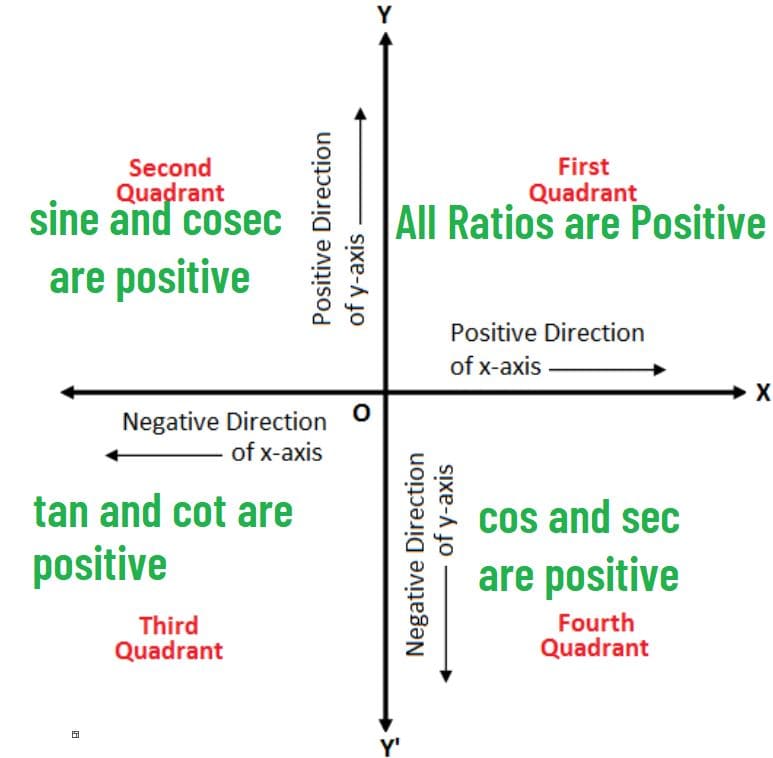
Signs by Quadrant (ASTC): Use the reference angle \( \alpha \) (the acute angle to the nearest axis). Decide the sign from the quadrant, then apply identities to the positive value at \( \alpha \).
- I (0°–90°): all \( \sin,\cos,\tan,\csc,\sec,\cot \) are \(+\).
- II (90°–180°): \( \sin,\csc \) are \(+\); \( \cos,\sec,\tan,\cot \) are \( - \).
- III (180°–270°): \( \tan,\cot \) are \(+\); \( \sin,\csc,\cos,\sec \) are \( - \).
- IV (270°–360°): \( \cos,\sec \) are \(+\); \( \sin,\csc,\tan,\cot \) are \( - \).
- Reference-angle rule: For any \( \theta \), compute \( \alpha = \big|\theta\big|\) mod \(90^\circ\), find the quadrant of \( \theta \), use the sign from ASTC, and evaluate the function at \( \alpha \).
- Identity + sign = speed: Reduce using identities first, then assign the sign via quadrant.
Solution:
\(150^\circ\) is in Quadrant II ⇒ sine is \(+\). Reference angle \( \alpha=30^\circ\). \[ \sin 150^\circ = +\sin 30^\circ = \frac{1}{2}. \]Solution:
\(210^\circ\) is in Quadrant III ⇒ cosine is \( - \). Reference angle \( \alpha=30^\circ\). \[ \cos 210^\circ = -\cos 30^\circ = -\frac{\sqrt{3}}{2}. \]Solution:
From \(1+\tan^2\theta=\sec^2\theta\), \[ \sec^2\theta - \tan^2\theta = 1. \] (True in any quadrant where both sides are defined.)4) T-ratios of Allied Angles Allied angles is an important concerpt
- Case (i): When angle \( \theta \) is negative
- \(\sin(-\theta) = -\sin\theta\)
- \(\cos(-\theta) = \cos\theta\)
- \(\tan(-\theta) = -\tan\theta\)
- Case (ii): When angle \( \theta \) is less than \(90^\circ\) (i.e., lies in I quadrant)
- \(\sin(90^\circ - \theta) = \cos\theta\)
- \(\cos(90^\circ - \theta) = \sin\theta\)
- \(\tan(90^\circ - \theta) = \cot\theta\)
- Case (iii): When angle \( \theta \) lies between \(90^\circ\) and \(180^\circ\) (i.e., in II quadrant)
- \(\sin(90^\circ + \theta) = \cos\theta\)
- \(\cos(90^\circ + \theta) = -\sin\theta\)
- \(\tan(90^\circ + \theta) = -\cot\theta\)
- \(\sin(180^\circ - \theta) = \sin\theta\)
- \(\cos(180^\circ - \theta) = -\cos\theta\)
- \(\tan(180^\circ - \theta) = -\tan\theta\)
- Case (iv): When angle \( \theta \) lies between \(180^\circ\) and \(270^\circ\) (i.e., in III quadrant)
- \(\sin(180^\circ + \theta) = -\sin\theta\)
- \(\cos(180^\circ + \theta) = -\cos\theta\)
- \(\tan(180^\circ + \theta) = \tan\theta\)
- \(\sin(270^\circ - \theta) = -\cos\theta\)
- \(\cos(270^\circ - \theta) = -\sin\theta\)
- \(\tan(270^\circ - \theta) = \cot\theta\)
- Case (i): When angle \( \theta \) is negative
- \(\sin(-\theta)= -\sin\theta\)
- \(\cos(-\theta)= \cos\theta\)
- \(\tan(-\theta)= -\tan\theta\)
- Case (ii): When \( \theta < 90^\circ \) (I quadrant)
- \(\sin(90^\circ-\theta)=\cos\theta\)
- \(\cos(90^\circ-\theta)=\sin\theta\)
- \(\tan(90^\circ-\theta)=\cot\theta\)
- Case (iii): When \(90^\circ<\theta<180^\circ\) (II quadrant)
- \(\sin(90^\circ+\theta)=\cos\theta\)
- \(\cos(90^\circ+\theta)=-\sin\theta\)
- \(\tan(90^\circ+\theta)=-\cot\theta\)
- \(\sin(180^\circ-\theta)=\sin\theta\)
- \(\cos(180^\circ-\theta)=-\cos\theta\)
- \(\tan(180^\circ-\theta)=-\tan\theta\)
- Case (iv): When \(180^\circ<\theta<270^\circ\) (III quadrant)
- \(\sin(180^\circ+\theta)=-\sin\theta\)
- \(\cos(180^\circ+\theta)=-\cos\theta\)
- \(\tan(180^\circ+\theta)=\tan\theta\)
- \(\sin(270^\circ-\theta)=-\cos\theta\)
- \(\cos(270^\circ-\theta)=-\sin\theta\)
- \(\tan(270^\circ-\theta)=\cot\theta\)
- Case (v): When \(270^\circ<\theta<360^\circ\) (IV quadrant)
- \(\sin(270^\circ+\theta)=-\cos\theta\)
- \(\cos(270^\circ+\theta)=\sin\theta\)
- \(\tan(270^\circ+\theta)=-\cot\theta\)
- \(\sin(360^\circ-\theta)=-\sin\theta\)
- \(\cos(360^\circ-\theta)=\cos\theta\)
- \(\tan(360^\circ-\theta)=-\tan\theta\)
| Angle \( \theta \) | \(0^\circ\) (\(0\)) |
\(30^\circ\) (\(=\frac{\pi}{6}\)) |
\(45^\circ\) (\(=\frac{\pi}{4}\)) |
\(60^\circ\) (\(=\frac{\pi}{3}\)) |
\(90^\circ\) (\(=\frac{\pi}{2}\)) |
\(120^\circ\) (\(=\frac{2\pi}{3}\)) |
\(135^\circ\) (\(=\frac{3\pi}{4}\)) |
\(150^\circ\) (\(=\frac{5\pi}{6}\)) |
\(180^\circ\) (\(=\pi\)) |
|---|---|---|---|---|---|---|---|---|---|
| \(\sin\theta\) | \(0\) | \(\tfrac{1}{2}\) | \(\tfrac{1}{\sqrt{2}}\) | \(\tfrac{\sqrt{3}}{2}\) | \(1\) | \(\tfrac{\sqrt{3}}{2}\) | \(\tfrac{1}{\sqrt{2}}\) | \(\tfrac{1}{2}\) | \(0\) |
| \(\cos\theta\) | \(1\) | \(\tfrac{\sqrt{3}}{2}\) | \(\tfrac{1}{\sqrt{2}}\) | \(\tfrac{1}{2}\) | \(0\) | \(-\tfrac{1}{2}\) | \(-\tfrac{1}{\sqrt{2}}\) | \(-\tfrac{\sqrt{3}}{2}\) | \(-1\) |
| \(\tan\theta\) | \(0\) | \(\tfrac{1}{\sqrt{3}}\) | \(1\) | \(\sqrt{3}\) | \(\infty\) | \(-\sqrt{3}\) | \(-1\) | \(-\tfrac{1}{\sqrt{3}}\) | \(0\) |
5) Solved Examples Study and practice the steps
6) Some important formulae of trigonometryPractice these
- \[ \sin(A+B)=\sin A\cos B+\cos A\sin B \]
- \[ \sin(A-B)=\sin A\cos B-\cos A\sin B \]
- \[ \cos(A+B)=\cos A\cos B-\sin A\sin B \]
- \[ \cos(A-B)=\cos A\cos B+\sin A\sin B \]
- \[ \tan(A+B)=\frac{\tan A+\tan B}{1-\tan A\,\tan B} \]
- \[ \tan(A-B)=\frac{\tan A-\tan B}{1+\tan A\,\tan B} \]
- \[ \sin 2A=2\sin A\cos A=\frac{2\tan A}{1+\tan^2 A} \]
- \[ \cos 2A=\cos^2\!A-\sin^2\!A =2\cos^2\!A-1 =1-2\sin^2\!A =\frac{1-\tan^2\!A}{1+\tan^2\!A} \]
- \[ \tan 2A=\frac{2\tan A}{1-\tan^2 A} \]
- \[ \sin 3A=3\sin A-4\sin^3\!A \]
- \[ \cos 3A=4\cos^3\!A-3\cos A \]
More important formulae of trigonometry
- \[ \tan 3A \;=\; \frac{3\tan A - \tan^{3}\!A}{\,1 - 3\tan^{2}\!A\,} \]
- \[ \sin(A+B) + \sin(A-B) \;=\; 2\sin A\,\cos B \]
- \[ \sin(A+B) - \sin(A-B) \;=\; 2\cos A\,\sin B \]
- \[ \cos(A+B) + \cos(A-B) \;=\; 2\cos A\,\cos B \]
- \[ \cos(A+B) - \cos(A-B) \;=\; -\,2\sin A\,\sin B \]
- \[ \sin C + \sin D \;=\; 2\sin\!\left(\frac{C+D}{2}\right) \cos\!\left(\frac{C-D}{2}\right) \]
- \[ \sin C - \sin D \;=\; 2\cos\!\left(\frac{C+D}{2}\right) \sin\!\left(\frac{C-D}{2}\right) \]
- \[ \cos C + \cos D \;=\; 2\cos\!\left(\frac{C+D}{2}\right) \cos\!\left(\frac{C-D}{2}\right) \]
- \[ \cos C - \cos D \;=\; -\,2\sin\!\left(\frac{C+D}{2}\right) \sin\!\left(\frac{C-D}{2}\right) \]